
Earthquake Express: Camp Fire and the 1964 Alaska Earthquake
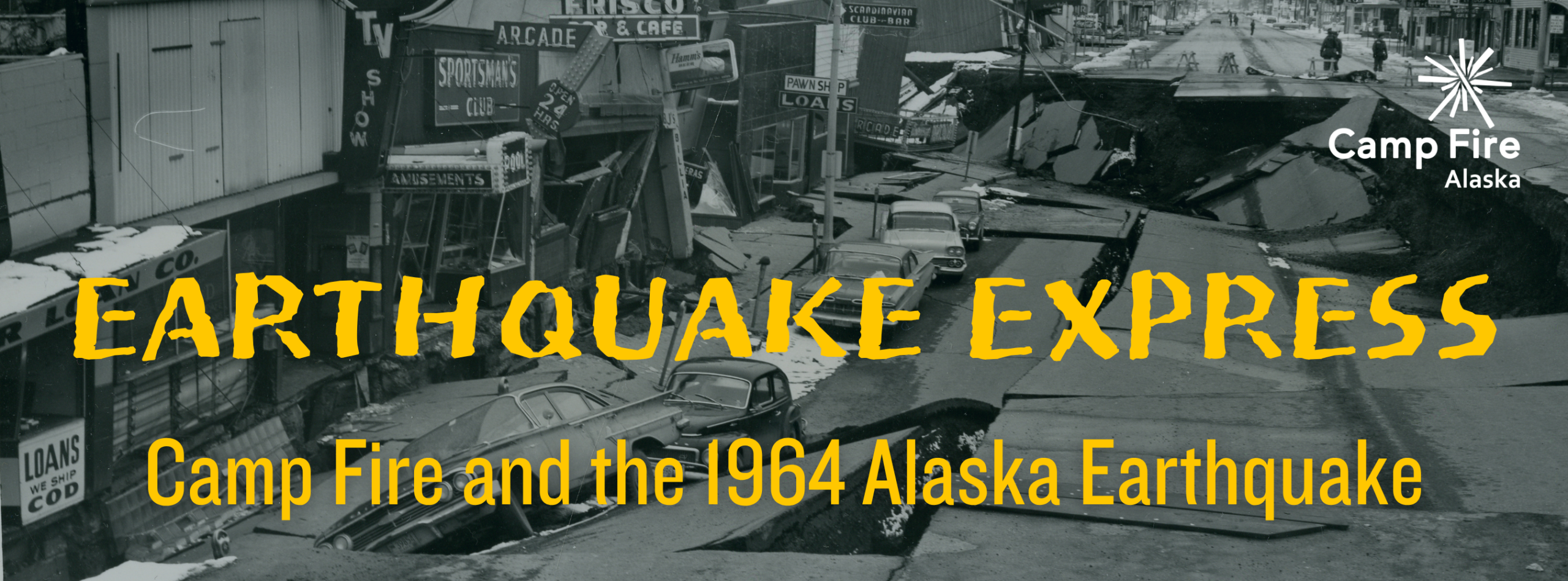
At 5:36 PM on March 27, 1964, Joan Hurst was wrapping things up at the office before heading to a Good Friday church service when she experienced the second most powerful earthquake ever recorded.
She was new to Alaska and less than a year into her role as Executive Director of the Chugach Council of Camp Fire Girls, now known as Camp Fire Alaska. It was also less than three months since their previous office building had burned down. And less than two weeks from her 37th birthday.
When the dust settled, Joan wrote a letter to Camp Fire friends and supporters to share her experience and that everyone was okay. It’s both somber and reflective yet filled with hope and even humor. Below are excerpts from the letter, and you can find a scan of her original letter here.
The excerpts, in blue text, have been lightly edited to improve readability.
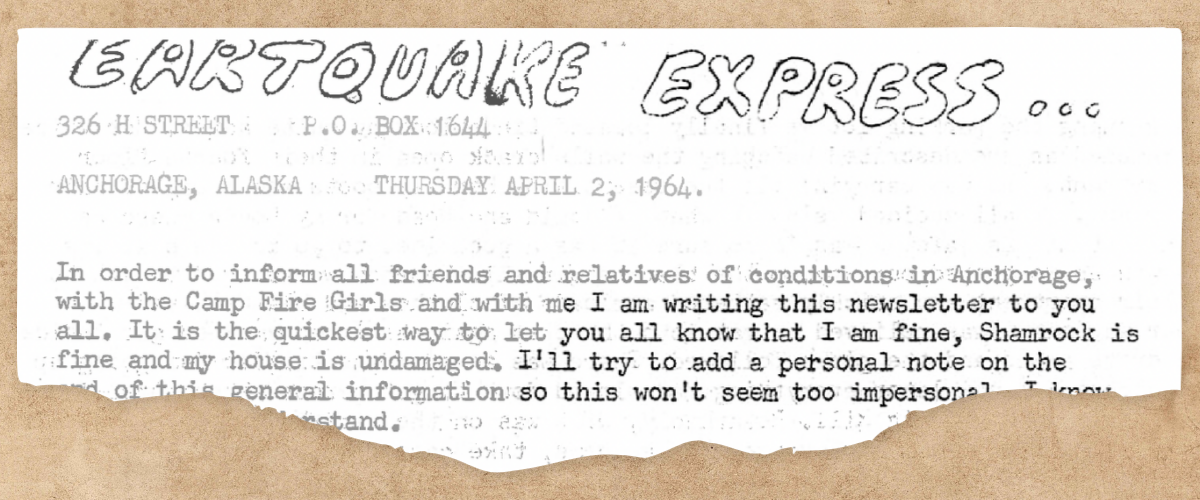
A digital clipping of the top of the first page of the “Eart[h]quake Express,” Joan Hurst’s newsletter to friends and relatives after the 1964 Alaska Earthquake.
In order to inform all friends and relatives of conditions in Anchorage with the Camp Fire Girls and with me, I am writing this newsletter to you all. It is the quickest way to let you all know that I am fine, Shamrock [her dog] is fine, and my house is undamaged…
…I think you might like to hear what things were like that fateful day. I’ll tell you what happened to me. I was in my office finishing up a few odd jobs before I went to Good Friday services at my church down the street. The windows started rattling and I thought to myself—”oh, another one of those tremors.” This is not uncommon in Anchorage. As I turned to go to the office across the hall (we are on the 2nd floor) I felt an enormous jolt which threw me against the door jam. Then the whole building was rolling and pitching with a rapid undulating motion that made it impossible to stand…
…It continued for at least two to two and a half minutes. Long enough for me to realize what was happening and to ponder the fact that I was on the second floor of one of the oldest [wood] frame buildings in town and I was sure the whole thing would crumble under the strain. I hollered to the secretary across the hall, “D-d-do you t-t-hink w-w-we should make a r-r-run for it?” … She fell to the floor and held onto the corner of the-desk; no answer came…
Joan describes items crashing to the floor as she “slithered” to the hallway between waves. Several others joined her and they “held on for dear life” waiting for the tremors to subside.
…We all ran into the street to see what was happening. My car was rolling back and forth at the curb. I noticed I had a parking ticket and muttered, “[darn] meter maids!” As I looked up 4th Avenue, I could see all the windows of the Northern Commercial Co. broken, it seemed to me then that we had suffered quite a serious quake, but I was sure it was just in the downtown area. Charmie Burke came running out of the beauty parlor calling to me. Her hair was in curlers and still wet. After a few minutes conference we decided to get the heck home…
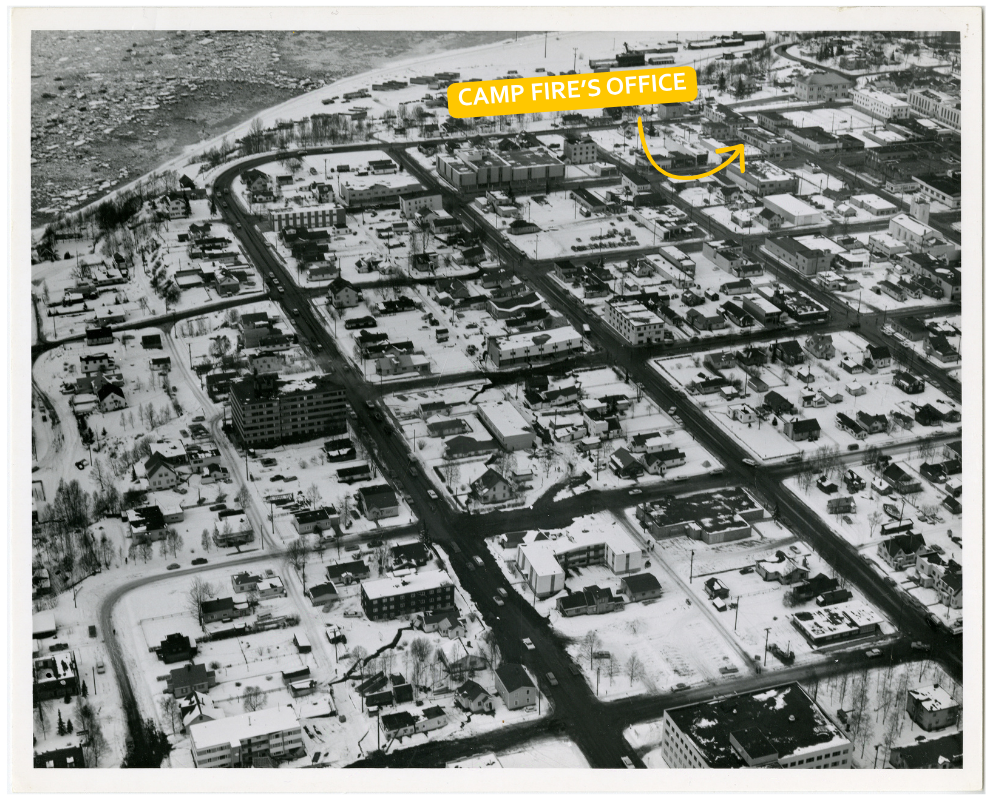
An aerial view of west Downtown Anchorage marked with the building believed to have housed the Camp Fire office in 1964. Prominent earthquake damage can be seen in the crack near the bottom left of the image. (1)
Joan describes heading back into the office to grab her coat and purse, knee deep in everything that fell from the shelves. She then helps Charmie find her roommate and goes with them to gather some belongings from their 14th story apartment. They climb the stairwell in pitch black darkness, smell gas inside, but manage to make it back down safely with an armload of clothes. The girls follow Joan to her house.
I found one very nervous dog and a completely upside-down house. Everything was turned over or upset, but strangely—only two hanging lights broken. Of course, every object on every shelf in every building in town was dumped on the floor, we found out later. Stores as well as householders had a gigantic job to do in cleaning up. Must admit, though, my place didn’t look too neat before the quake!
A quick check revealed all the neighbors were well. After clearing a path through the house, we all went over to the Hansons and had a bowl of hot moose soup, which Jo had heated on a Coleman stove. Listening to the radio, a portable one, was the best way of getting news. Over and over, they announced that people should go home and stay there. We surely didn’t want to do anything else!
Joan says the extent of the damage was revealed slowly as reports came in. The entire city was without water, electricity, gas, heat, or phones—but the authorities were setting up emergency shelters. She stayed up late with her friends, listening to reports, “huddled in blankets in the dark.” News came in about the devastation caused by tsunami waves in coastal communities. They worried what their friends and family were hearing. But there was no contact with the Outside, only ham radios and military aircraft.
Ready to Dig In and Rebuild
The next day, Joan visited Camp Fire friends and found most of them well, though some had lost their homes. She tells the story of a Camp Fire Blue Bird who saved her brother and sister as they were fleeing the house. Sadly, two siblings were still inside when they were “swallowed in a crevasse that simply opened and then closed over them.”
It is indeed tragic to hear of all the terror and deaths that were a result of the earthquake. One should not however loose sight of the fact that while we mourn the loss of these fellow Alaskans, everyone up here is amazed and grateful that the toll of deaths and injuries was remarkably light considering the amount of property damage suffered…
…Some commentators have expected vast numbers of Alaskans to flee the ruins and move from the state. We hate to disappoint them, but I only know of a few families who were going to move and then only temporarily. Most everyone I know is staying put and getting ready to dig in for the big cleanup…
…I hope this doesn’t sound like we are glossing over problems and oversimplifying them. There will be lots of hardship and hard work endured before things are right again. What I’m trying to point out is that it seems people here are not overwhelmed or defeated by this blow. They are standing ready to start fresh and hope to rebuild what was lost—and make it better if possible.
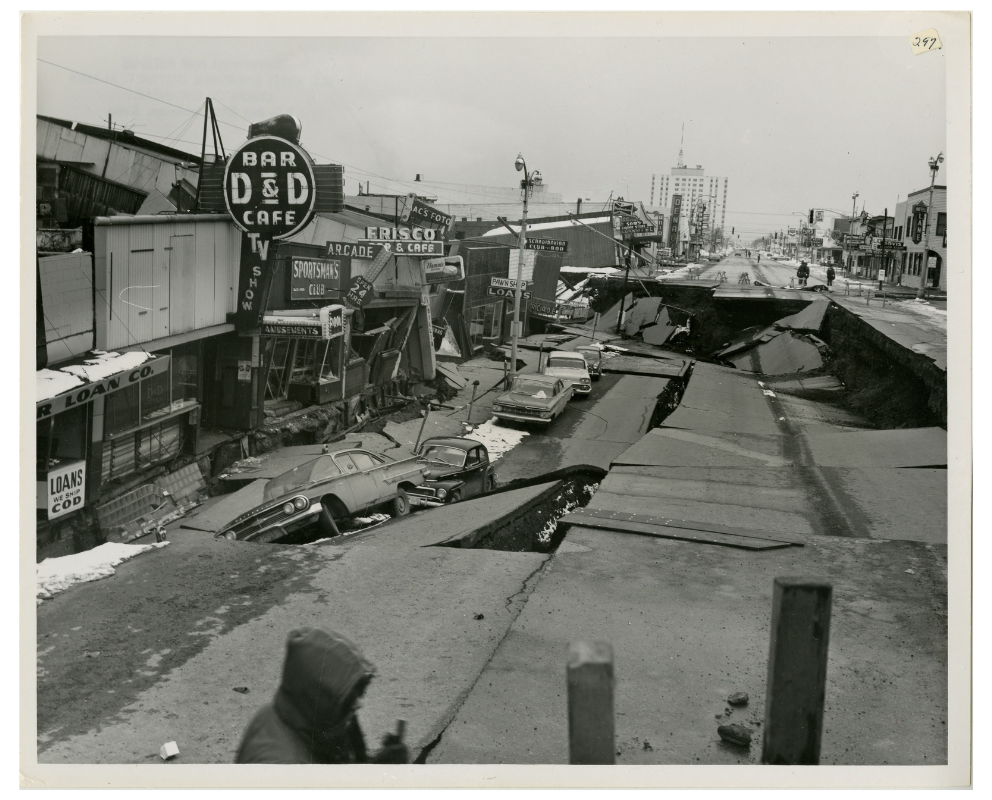
Looking east down 4th Avenue in Downtown Anchorage, only a few blocks from where the Camp Fire was during the 1964 Alaska Earthquake. (2)
Joan begins to close the letter by remarking how the Camp Fire program has “suffered its second setback of the year,” referencing the New Year’s Day fire. They had just relocated and still hadn’t received their new furniture—now it would be delayed because of the earthquake.
The furniture is something else—I don’t know what it is doing for our public image, but it does not exceed two folding chairs (one bent) and a rickety table. The quake did not do too much damage to the contents of our office (what was there to hurt). Total loss: 4 squashed boxes of mints—and we ate them.
She writes that that Camp Fire board will meet to make plans about their next moves, including how the organization can support the restoration of the city. She notes that with fundraising already low, she expected the next giving season to be even more challenging.
But somehow, we feel we can solve these problems. Do not feel sorry for us—the program is growing and is taking hold in the community. Earthquakes and fires and being poor don’t matter to the children who are getting a good experience in a group. All this, you see, gives me and all our fine board and leaders enough to keep plugging…
…Be assured that things are getting back to normal. There would be some who doubt me—but Alaska is really a fine place to live! Come see for yourself.
The Beginning of a Legacy
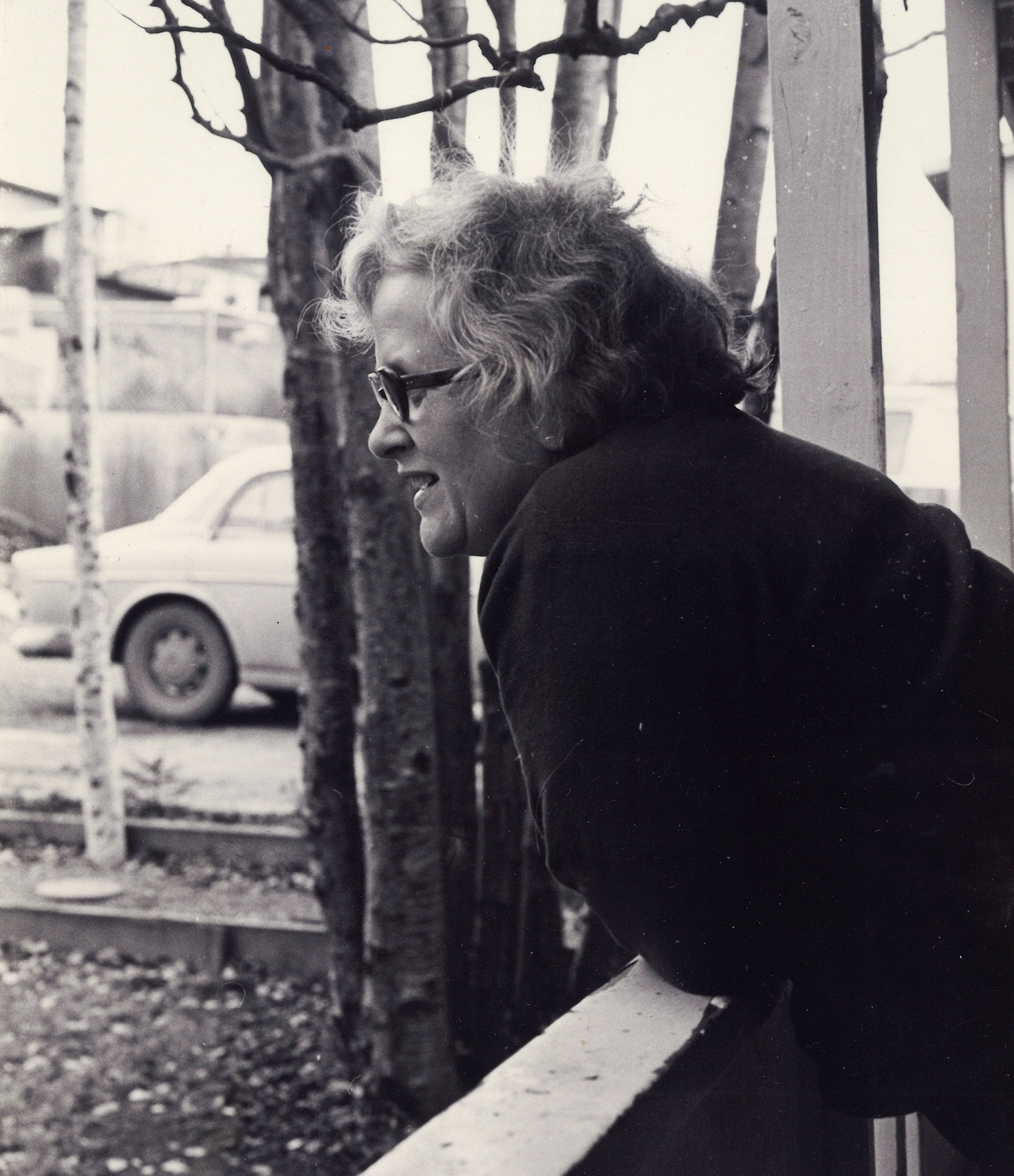
Joan Hurst, Camp Fire Alaska’s first Executive Director, at her home in Anchorage. (3)
Joan would lead the organization for another 34 years. Before she retired in 1998, Camp Fire in Alaska grew from 350 to over 5,000 children. She built Camp K on Kenai Lake, designed the curriculum that became the basis for expanding Camp Fire’s before and after school program nationwide, created Alaska’s first water safety program for kids in rural Alaska, and was a lead advocate for what eventually became Alaska’s Child Care Assistance Program.
Alaska threw a lot at Joan in her first year here, but it never dimmed her spark. Not even a magnitude 9.2 earthquake could slow Joan down in her mission to be a champion for children. Her legacy continues today, not in just the programs she created, but in the values she instilled for those doing this work: hope, joy, grit, humor, and most importantly, a relentless drive to “keep plugging,” no matter how overwhelming the circumstances.
Image Credits
(1) Department of Defense. Department of the Army. Office of the Chief of Engineers; National Archives and Records Administration (NARA), NAID 25341415. https://catalog.archives.gov/id/25341415
(2) Department of Defense. Department of the Army. Office of the Chief of Engineers; National Archives and Records Administration (NARA), NAID 25341423. https://catalog.archives.gov/id/25341423
(3) Date and photographer unknown. Joan Hurst Archives. Camp Fire Alaska.